







| Listen to Prabhaata-rashmih Audio |
Harih Om Tat Sat. Jai Guru. Jai Guru.
Ma is saying that in Naimiśāriṇyam, during these days especially during the Nāmasankīrtana, there is a lot of devotional festivity giving rise to even ecstasy, so to say. This ecstasy is not produced by any external object or even interaction. If at all, every devotee is in the midst of a number of others and like-minded people, devotionally inspired people, seeing them is always something very pleasant. People who are given to drinking, if they find other people who drink, they also feel happy. This is a happiness produced by like-mindedness. But the difference is not there. The difference is how this like-mindedness is based, what is it based on? There lies the devotional difference.
We are trying to enter into our own mind and heart through the fondness and affinity towards something very supra-worldly in character, not any worldly object but the cause and source of the world, namely God. This festive mood and festivity generally is occasional produced by a particular situation on a particular occasion lasting for a short while. This again is depending upon an external situation. So as long as you are in Naimiśāriṇyam, as long as you are listening to or seeing something, this ecstasy will be had. When the external situation vanishes, the ecstasy or attunement also will decline and vanish. So we reach a crisis.
The same thing appears when you are able to get absorbed in meditation and the meditation produces bliss. When you get up from meditation, the bliss will not be there. If at all it is there as an impact, that will also taper off. So the question should occur to all the devotees as to what is the methodology by virtue of which I can always remain devotional and the devotional attunement will be there?
When you start thinking in this manner devotion should become a value and a value enrichment for you. This is where enquiries like the one Nimi Chakravarty makes, he tells the nava yogis, nine yogis, “Please tell me what are the characteristics of a true devotee which will please the Lord and the Lord will be pleased to give his own self to the devotee?”
See, it is a very patient enquiry. The emperor is not in any devotional ecstasy. He doesn’t want it also. He wants to know how devotion can be imbibed as a quality and an enrichment as a result of which the devotee will feel sufficiently devotionally fulfilled. So the transformation has to be a value transformation, a qualitative transformation.
Generally suppose, you go near God, you wanted to see Him. When you get close to Him, you will go on looking at Him, looking at Him. Maybe one day, one week, two weeks. After sometime what will you do? “My dear God, I wanted to see you and I am by your side. Will you please tell me what shall I do as a piece of service for You?” Initially the joy of seeing God was there. After experiencing it for a while or for a sufficient while, you feel that I must do something as a devotee. It may be a physical bodily expression, it may be an oral expression, it may be a mental expression, it may be an intellectual expression.
If you ask me, “What is the transformation that came to me?” I left my job, I left Calcutta, I left my blood relationship. The idea was to live and move in this world constantly coupled with God. And what naturally came to me was the life of exposition. I started sharing my thoughts with the others. That means it became an occupation. I have to occupy my mind by reading the śāstrās, by listening to them, by thinking about them, by explaining them. So my life was mostly in the company of enquirers, devotees, seekers and they started coming to me, an Ashram was born, we used to host them, I used to be invited. You know, see? The whole life got transformed.
If you feel that there is something called devotional ecstasy then understand that devotion is a pursuit and try to pursue it for a longer while and as soon as possible if you can, pursue it in a wholesome, life-long manner. This transformation can be had only by understanding the qualities of devotion. The qualities are applicable to the mind emotionally. It is one of loving people more and more, never hating them, never disliking them, and the range of love should go wider and wider, broader and broader. You must be able to adjust and make sacrifices for the sake of others. Selfishness should dwindle, should vanish and other-ishness should dawn in your mind and increase. As you are selfish now, you will become interested in the welfare of others.
See, the satram is going on. Every time my mind thinks about whether something has been done well. I had told last year itself that people should not be allowed, made to stand on the sun. This time we extended the pandal. So the main set of people were standing under shade. Day before yesterday, I found that people were to some extent on the sun on the left side. So I told them, “This should not be, some canopy should be provided.” What do you understand from this?
The function is going on. It is not a question of feeling elated by it. Is it well done? Is it properly done? What further facility or improvement can we do? Don’t think that it is not devotion. I don’t need the ecstasy of devotion but I need the refinement, the harmony and the sensitiveness of devotion. So the joy gets raised from the emotional level, what can I say, to the intelligence level. Devotion becomes knowledge. It becomes a knowledge refinement. And it is very refined, the mind becomes more sensitive, more pure, more sublime, more aware of things and the intelligence seeks to improve matters.
So, Nimi Chakravarthy wanted to know, “What are the qualities, virtues and embellishments which I can imbibe in myself as a result of which I will become most acceptable and pleasing to the Lord?” Just see? It is not singing for a while or dancing for a while. It is elevating yourself to a level where Lord himself will be pleased. Who will the Lord get pleased most? He will be pleased most with the person who speaks about Him, explains Him, who is able to instill and inspire others in the path of devotion.
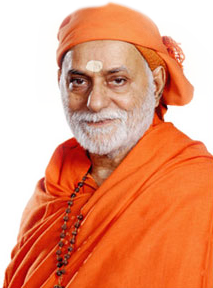
That is why Krishna says in Bhagavad Gita, whoever discusses this subject Bhagavad Gita’s dialogue amidst my devotees becomes the most excellent person. There will be none already born or is there or will be born who is as close and as dear to me as this person who discusses this dialogue amongst devotees. That is why I say, I am one of the first who is most pleasing to Lord Krishna. For the past 57 years I have been only discussing Bhagavad Gita, you can say. A long life of 57 years and I was doing it as a renunciate. Means what? I have no other resources, I have no other job or task. Only live the life of Gita, thinking about it, contemplating upon it, explaining it, trying to inspire people, get them involved in.
This time we are giving a new focus for Vishnu Sahasranama Vishva Yajna Mahotsava. I thought we should do something very global. If we continue to live and the program goes on, we would like to strike at something still deeper and loftier so that people will have more involvement and greater, in the modern language, challenges and application. But we want to make it enlightened, educative and elevative. Therein lies our specialty. I think the only way will be to think repeatedly and imbibe in you the qualities, virtues and embellishments of devotion. Then you will find the life will be transformed and instead of practicing devotion you will become a devotee and your life will be a full expression of devotion.
Harih Om Tat Sat. Jai Guru. Jai Guru.


