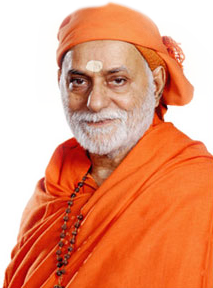









The real austerity
In retrospect what may appear to be very austere days, were not really felt to be “austere” at the time. While actually living those days I did not feel any difficulty or lack. There was no “struggle or striving to accept” the situation. Everything was ‘sahaja’ or natural. There was the joy of flowing with the stream effortlessly.
Swamiji had written to us before we came away to the Ashram: “Come cheerfully. Be relieved. Now the burden is mine. I shall bear it. We shall share our fortunes and misfortunes, joy and sorrow. Shall teach you how to remain afloat.” Perhaps the burden was surrendered automatically, and that brought forth the effortless-ness.
As far as I remember, the mind was completely focused on the spiritual goal of Brahma-niṣṭhā. It was ready to embrace wholeheartedly whatever came naturally. If at all there was any expectation, it was not regarding any physical comfort, food or modern conveniences we were used to. It was rather to live a renunciate’s life as it was in the hermitages of ancient India, steeped in simplicity, asceticism and deep contemplation.
And the real austerity I had to undergo at the time was to outlive this expectation, as most of the time was spent in hectic activities related to administrative responsibilities of the Ashram. There was hardly any time for study or contemplation.
By nature, I was given to extreme punctuality, order and cleanliness. Whether it was in Kolkāta or later in Kharagpur, our small simple household was free of any decorative paraphernalia and it was not difficult to keep everything clean and tidy. Anything not used over a period of a few months would lose its right to be there, and would be disposed of without delay.
Particularly, the life of the teachers in IIT-Kharagpur campus was extremely simple. Our house surrounded by abundant ancient trees, snakes, squirrels and birds – not to speak of the “humanly” dog – was very much like a forest hermitage. The days were lived in deep discussions and contemplation. The simplicity and innocence of the gardener and the young girl from the nearby village helping us in domestic chores, added to the peace and purity of the ambience.
When we came to the Ashram, there was nobody to run the place. To keep the entire area tidy, to maintain the buildings, gardens and the coconut groves, and to look after the guests, with the assistance of a few workers whose language and manners we did not know, was not easy at all. The workers also were initially not too happy to have sudden supervision over their ways, that too from two “foreigners”.
So, the real austerity was to deal with the uneasiness of the mind that was naturally given to order, discipline, peace and harmony. The integrated sāttvika state of the mind was the result of our previous sādhanā to create a sāttvika world around; but now the time had come to take to the new sādhanā of transcending the sāttvika bondage – the desire for harmony and knowledge.
Being harmonious with disharmony
One morning, Swamiji asked me: “What has happened to you? Mataji was telling me that your face does not look cheerful.” I tried to explain my torment, and told Swamiji that I was not able to tidy up everything in the manner I would like to.
Swamiji explained to me the sādhanā of moderation: “We should be able to remain harmonious even in the midst of apparent disharmony. To remain unaffected even when the situation is not as expected, but to carry on with one’s effort towards perfection, is samatva.”
I understood why Swamiji used to say that an Ashram in its involvements and activities is many times a household, and an ordinary householder with his constricted mindset will not be able to look after the affairs of an Ashram. One has to be very large-hearted, loving, non-possessive, impartial and sacrificing. Of course, all these qualities automatically flow from the sādhanā of desireless-ness.
Apparently the activities in an Ashram are not different from the worldly activities pursued in the household or in the office. The difference lies in the mind of the performer. The work becomes worship or yajña when it is not performed with the aim of any selfish gain or ego-satisfaction, when it is done transcending likes and dislikes.
I also told Swamiji: “By nature I am given to working in a systematic manner. Here, the constant multidirectional involvement and relentless interruptions do not allow me to do anything properly, especially if it is writing or editing work. Swamiji, I feel if I could get one hour in the morning for deep contemplation and study, I would be able to carry on the rest of the day with all the various activities. But mostly even that one hour to integrate my mind is not available.”
Swamiji explained: “The difficulty comes from our Bheda-buddhiḥ or differential notion. We look at some activity as spiritual but others as worldly. That way most of the work we do throughout the day remains worldly, and the mind starts getting restless, thinking: ‘when shall I do my spiritual sādhanā?’ To make the sādhanā constant, this differential notion has to go and the whole world must become Godly.”
My mind was not satisfied. I thought: “I do not have problem in doing anything any time of the day; but could not things be done in a more systematic way? Will not then our efficiency also increase?”
Impartial love for all
My mind went on thinking: “But how is it that Swamiji never feels disturbed? Anybody calling him at any time, whatever he might be doing, he leaves the job and attends to the call. Even when there is some important work waiting, he spends long time listening to people – may be a devotee or a help-seeker.”
In fact, we find in him an embodiment of the scriptural statement:
any time whatever comes to be done, good or bad, he does right then straightforwardly
(without the twist of ego); his motivation is like that of a child.
Once a Tamil mendicant had come to the Ashram asking for alms. Swamiji started asking him lovingly about various aspects of his life. I left the place to attend to some other work. When I came back after about half an hour, I found both Swamiji and the mendicant sitting on the floor of the verandah. There were coins spread all around, and Swamiji and the mendicant together were counting the money!
What had happened was: while enquiring about his life, Swamiji had asked him how much money he had got that day by begging. Hearing his reply Swamiji suggested that why not they count it. The mendicant opened his bag and poured out whatever was there. And that is how the two were seriously engrossed in the important work!
I felt that the secret of not feeling disturbed lay in Swamiji’s impartial love for all. What I had to grow was this impartial love for people.
Harmonizing the differences
The other suffering my mind had was difference of opinion with Swamiji in certain matters. Particularly, Swamiji’s acceptance of some apparently wrong behavioural traits of some devotees, and responding favourably to some suggestions which, according to most of us, were not at all dignified or auspicious. These devotees sometimes were residents of the Ashram, or in some way associated with the Ashram. In some cases, they were even unknown admirers.
It often made me think: “Whatever qualities we have learnt throughout our life as virtues, as codes of righteous behaviour, or honesty and straightforwardness – are they all wrong?” But then, it is said that a Mahātmā is known by his love and tolerance towards the so called bad or difficult people. Swamiji always says that there is no greatness in being good to the good people; the real goodness lies in being good to the so-called bad people also.
Another aspect that used to pain me for years was the difference in my style of functioning with that of Swamiji. I had to learn to live with it, sometimes keeping away my style, sometimes keeping to my style, and sometimes taking a moderate line of action. Slowly I realized that the differences may pose some functional problems requiring some functional adjustments, but they should not really affect the relationship – provided the ego is kept away.
There is a widespread misunderstanding about Guru-śishya relationship. People think that a good śishya should be a replica of the Guru. Were not Swami Vivekananda and Sri Ramakrishna poles apart in their personality as well as in their life and actions? Were the twelve Sannyāsin disciples of Sri Ramakrishna identical? What about Baba and Swamiji? In their realization of the absolute Truth, the Guru and the śishya might be the same, but when the realization expresses naturally through the personality, will not the expression take the characteristics of the personality? All Saints will be engaged in loka-saṅgraha, but each in his own way – according to his svabhāva.
Fundamental Identity
Whatever might have been the functional differences with Swamiji, there was never any conflict or difference of opinion regarding upholding the spiritual values, especially the highest ideal of renunciation, straightforwardness, non-possession and purity. Time and again in the history of Narayanashrama Tapovanam, critical situations had arisen where Swamiji’s spontaneous behaviour or considered firm decisions exemplified his uncompromising adherence to spiritual truth and purpose. Those moments, in the contrasting background of suggestions from devotees and well-wishers for taking a more comfortable path, remain like the guiding stars in the life of true seekers.


