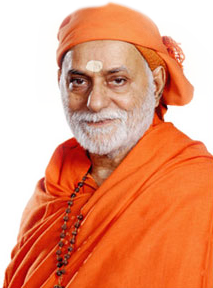








In Gurusannidhi - 5
The chilly month of December marks the beginning of the Sabarimala yatra season. Pilgrims, not only from Kerala, but from all over India, particularly from Andhra, Karnataka and Tamil Nadu, flock to Kerala to visit the Swami Ayyappa Shrine atop the picturesque Sabari Hills on the bank of the river Pampa. With the cold winds blowing, the pilgrims clad in black dhoti and a black upper garment, trek barefoot, the steep hills carrying their burden of Irumudi (the irumudi is a twin cloth bundle containing grains, coconuts and some articles for worship, symbolizing the pilgrims’ praarabdha) on their heads. The hail of ‘Swamiye Saranam Ayyappa’ reverberates all over Kerala during the season.
B, an ardent devotee from Tamil Nadu, was on his way to Sabarimala. En route, he decided to spend a couple of days in the Asram to be at the feet of Swamiji.
With a lot of compassion, Swamiji drives home the truth concerning devotion, devotee and the object of devotion. Vedanta is quite precise- almost merciless- in its exposition and the logic is stunningly irrefutable. The so-called pedantic devotee wakes up with a jolt to the status and refinement of a true devotee and a lover of God in full enlightenment after listening to Swamiji earnestly.
After dinner, Swamiji called B to the verandah. It was just about 8.30 p.m., the time for satsang, and the others were yet to arrive. Usually, during the satsang, we sit on the floor in front of Poojya Swamiji and chant the invocatory verses. That day Swamiji himself recited these verses as soon as B and P, another devotee from Malaysia had seated themselves. Hearing this, S and I hurried to be at Swamiji’s feet. Swamiji, in his beautiful voice, completed the chanting and began to address B
* * *
“B, I will today completely dispose of this myth of devotion and the relationship between devotee, devotion and God.
“See, assuming that there is a special presence of God or divinity in a shrine and assuming that that divinity is looking at you when you go there- when you stand before it and pray- assuming that it does so, even then, on what particular ground, quality or merit will that presence sanction the prayer?
“Hundreds of devotees go there, and they do similar prayer. Prayers of some devotees get fulfilled while of some others do not. What is the reason?
“So, assuming that there is a presence and that the presence is going to sanction the prayer, will not the sanction obviously depend upon he intensity of the devotee’s prayer and the purity of his mind? The other factor in sanctioning the prayer is the divinity or God; that is common for everybody. If your prayer is going to be sanctioned in proportion to its own quality or deservingness, then why bring any other factor at all?
“Make your prayer intense; make yourself pure, and the prayer will be granted. For that do you have to go to a particular temple or an idol? Do you understand? Even if you go, the Divinity involved is the same as is present everywhere, including your own within.
“So, in the whole course of devotion, why are we looking to God? Looking to God is just like using a walking stick- holding it, pressing it on the ground as a help while walking. Just like in the other walks of life we are using various instruments or gadgets, here the same human being is using a religious gadget or aid for his religious purposes.
“In Sreemad Bhagavatam, many practices of devotion are discussed. The beginning of the text is very significant. The Brahmanas ask Suta (Suta is a special folk of storytellers who are well read and honoured in the society), ‘you have read a number of sastras, itihasas and puranas. Please let us know what is the essence of all these’. The suta proceeds to tell the listeners:
It is in fact the non-dual knowledge that Knowers speak of as Brahman, the Supreme reality, the Paramatma or Bhagavan.
“So, your Bhagavan, Paramatma or Brahman is actually the non-dual knowledge.
“Whenever you refer to knowledge, where is its focus? It is in man. Whenever you say knowledge, it cannot belong to a pillar or earth or water or to sun or moon. Nowhere will you find knowledge. Knowledge is there only in man. When this knowledge becomes non-differential, non-dual – that is the pinnacle.
“This is a great declaration, dear B. We generally know of substances and their ultimate nature. But here the ultimate Reality is no more a substance- it is knowledge! How can knowledge be equated to a substance? Is there any other place in the world where it has been declared that knowledge is the Supreme ultimate substance?
“Now, we go to another part. What is meant by this non-dual knowledge? Normally, right from the time the child is born it starts looking at the objects- it starts perceiving the surroundings. Starting with senses of touch, sensing the warmth of the mother’s touch, the child progressively collates the sensations from all the five senses to gain an impression of the world around. Then knowing starts. B, knowledge is no other than the condensation of the experiences, be they interactional or sensory.
“In all sensory perceptions, differentiation seems to be the very basis of our experiences and knowledge. Now, we have to extricate the knowing process and knowledge from the stronghold of this differentiation and make it non-differential. Is it possible? If you ask me that alone is possible!
“Here now I would like to tell you an important point. See, when do I say that I am seeing an object or that I have seen an object? The object remains outside and when I look at it, an image of the object is formed in my retina, inside me. It is this image, which I refer to as the object outside. So, I am concerned with the image, which is now actually part of me. Can you tell me then: Is the perceived object an object or is it the subject itself?
“This is true with all the impression gathered by the senses- be it touch, taste, smell, sight or sound. Everything becomes subjective. Everything becomes part of yourself, the perceiver. Understanding it this way, are you not able to completely nullify the objective differentiation?
“So, B, when you stand before the idol of Ayyappa, or before any other Idol, or the variety of the universe, you are only experiencing mere images in your own Self. When thus you become fully conscious of the subjectivity of all experiences and this subjectivity overwhelms all objects, the differentiation caused by them vanishes and uniformity shines in all its brilliance! Then you have won the game; nothing in this universe can overpower your mind with either appeal or even repulsion, any more. This is not merely an intellectual position. It is actually an experiential stand!”
There was an air of stunned silence all around as Swamiji thundered these words. Swamiji sat silently with his eyes closed, spiritual vibration passing all over his body. His face radiated bliss and santi. After a few minutes thus, Swamiji again started speaking:
“So far your devotion was a practice. Now it becomes a feeling! An intense feeling of love, and oneness! Everything is me….everything is me…. Everything is me….I am in everything! (Swamiji’s voice trails into a soft whisper) The mind melts with love! This is devotion. I wonder if you have all been able to grasp the meltingness!”
-A devotee


