







| Listen to Prabhaata-rashmih Audio |
Harih Om Tat Sat. Jai Guru. Jai Guru.
For many weeks and months now, I have been discussing Bhagavad Gita right from the start for the evening satsang sessions. We have discussed the most important part of Bhagavad Gita, namely the beginning, the first chapter; the first exposition and revelation Krishna makes, the second chapter which is revolving around the identity of the human personality, everyone’s identity. In other words, it discusses and exposes the core of human personality.
We always say that man is mortal. We are mortal. But Krishna explains that we are immortal, not mortal. The mortality applies only to our body. You can apply it even to the mind, intelligence and ego which are constituents of grand nature. But our personality is beyond that and that is the core and the center. That is immortal right through and through. This is a great revelation. It gives you an identity on the one hand, it also showers immortality on the other.
If we are able to understand this identity and immortality, I think you can face all the problems, challenges and persecutions of life. What we have to muster is our own inner resources. Compared and contrasted with our inner resources, the external resources whatever we find displayed by nature, they are a trifling. This does not mean that we don’t want the external resources. Our own body is external. The whole world is external. Embodiment means to be involved in this external, to be interacting with them. But while interacting with them, in order to face every kind of a situation and circumstance, the right resources we have within ourselves. When you understand this, it is a great discovery, discovery, discovery. Krishna explains it so rationally that nobody can disagree with him. Everybody is forced to accept lovingly and with self-persuasion.
Then he discusses the place, purpose and philosophy of activity and interaction in the third chapter. I wanted to remind you that Bhagavad Gita is a dialogue that transpired in the battlefield of Kurukshetra just before the commencement of the war. And Krishna repeatedly exhorts Arjuna in the second chapter. Therefore: Yudhyasva Bhārata (Bhagavad Gita 2.18). “My Dear son of Bharat or Bhārata-vamśa, fight, fight, fight.”
For Arjuna, it was fighting. For everyone it is acting, living, interacting with the world. So the common and universal exhortation to everyone will be, ‘Therefore act and interact. Live and let live’. At no point of time, we should have something like a resistance to live, a dejection to live, a disappointment to live. Life is endearing every time and we should not feel the least disheartened. But we do feel and the problem is attacked in this way. Any such feeling of resistance, unwillingness, disappointment, dejection, all these are products of ignorance and delusion. Ignorance of what? Ignorance about the complex and all-folding nature, ignorance about your own true identity, the existence of the soul which transcends body, mind, intelligence and ego. So inwardly, no problem affects you and externally, everything is inevitable.
If you encounter a suffering, within the suffering and the law of suffering itself is the fact and compulsion that our life has to be sustained to become a subject of suffering. If nature or providence puts you to suffering, that will have no meaning if you happen to die. Only when you live, you can enjoy as well as suffer. So the law of suffering tells us that the victim has to be preserved to make him a victim of suffering.
Ultimately Bhagavad Gita will tell that you don’t have to do anything but drop your choices, preferences and prejudices. Make your mind un-constricted. Make your mind flexible, flexible and assimilative. You are like the ocean and the space. Initially become the ocean with reference to the incoming rivers. The rivers have originated from the sea, similarly all interactions are originating from you and they come back with their impacts, like the rivers with their dirt and slush. But understand that you have the ocean-al mind which has got the capacity to assimilate everything.
Go a step further and become spatial. That spatial nature when realized, just like within the womb of space, innumerable, countless planets and celestial bodies are there, each has its own property, pull and push, but space itself is the least affected by them. They are all born of space itself, sustained by space itself and they will dissolve, if at all in space itself. Such a space, the source, the terminus and the sustenance, that has no affectation at all. Like that, you perceive the world, you interact with the world and you enjoy and suffer the impacts in the process. At no time, none of these can exceed, excel or outwit your mind. It is a question of your understanding.
Why I am saying all this? I would like every one of you to think and adjudge, evaluate whether Bhagavad Gita is a religious gospel or not. Or it is a gospel on human life. It may have some religious and quasi-religious or connected ideas presented there, because any philosophy of life should also embrace religion because religion is very much part of human thinking. So whatever thought processes were there during Krishna’s time, he discussed almost every one of them relating them to his own discussion. But the discussion itself was a human and an interactional discussion.
How to live life? How to look at life? How to look at the world? How to look at the interactions between the individual and the world? What will all this mean? What it should mean? And wherein lies the methodology or the process or the pursuit by which the living individual will never be outwitted by the world impacts? Krishna started with an exhortation, not to be unduly sympathetic, but to understand life and its involvement. He ends up saying, “Did you listen to me well, my dear Arjuna? Have you thought about it? Have you heard? Is your delusion gone, ignorance gone? Where do you stand now?”
Arjuna says, “All gone by your grace. I will fight, not merely one Mahabharata war but a score of them. I will do whatever you want.”
So the resistance was gone, the delusion was gone, the fear was gone, the indecision was gone, irresoluteness was gone, and Arjuna was able to get his own poise and stability. Now Krishna says, “This conversation is very precious. Whoever studies it, understands it and makes use of it, certainly he will attain the Supreme gain of human life. Whoever takes the trouble of discussing and explaining this dialogue to people, that man is doing the best of service for me. I would like to say, Krishna says that “A man who takes up the task and mission of exposing this to the seekers and devotees, that man is the most dear to me. Nobody in the past was there who excels him in his goodness, in this devotion and in his excellence. And none is living like him and nobody will ever be born.” It is a very great statement. Nobody was there, nobody is there and nobody will be there. So the place he gives to the one who exposes this dialogue is so high and so lofty, so exalted.
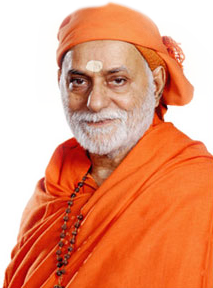
Somehow, your Swamiji has been given to exposing Bhagavad Gita for the past sixty years. I always make it a point to discuss Bhagavad Gita, one aspect or the other of it. Initially, it was chapter after chapter. Later on, it became concept after concept, in the evening. Because we have a group, a crowd of people who always like to listen to Bhagavad Gita. Very rarely, I have made the evening discussion on a different subject like Yoga-Vasishtha or Srimad Bhagavatam. You can say 99% of my evening sessions have been devoted to Bhagavad Gita. And even now after taking Srimad Bhagāvatam, when I have been discussing Bhagavad Gita in ‘Muktisudhakaram’, I find this has a better rapport with the people. The other has got devotion. It’s very good. But in Bhagavad Gita, the actual life is discussed and the relevance is far more.
Where are the people who will say, “I am a devotee, I want to excel in devotion and I will only chant the name of Lord and remain in my life”. Only retired people will say that. Otherwise, for all of them it is life, life, the implications of life, the challenges, the challenges and the persuasions. It can be domestic, it can be social, it can be professional, it can be religious also.
So I would like you to think about Bhagavad Gita in its own proper making and relevance and then see that as many people as possible are told by you about the secular character of Bhagavad Gita discussion. All philosophies spring from us and we are living in the world. So everything is an extension and projection of the world and the world itself is an extension and projection of ourselves, our mind.
Harih Om Tat Sat. Jai Guru. Jai Guru.


