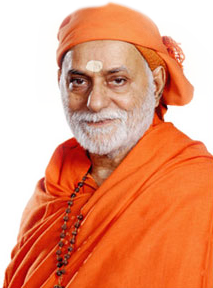







[Concluding part of the talk delivered by Nutan Swamiji on 28th December 2005
in the 4th Sreemad Bhaagavata Tattva Sameekshaa Satram.]
For the Pleasure of the Lord
So, we found that the various names with which the devotee is addressing the Lord, in truth mean the all-pervading Consciousness, the Self or Brahman. And finally he says:
Prātaḥ-samutthāya tava-priyārthaṃ
saṃsāra-yātrāṃ anuvartayiṣye
but only for Your pleasure: tava-priyārtham.
When the so-called worldly interactions are undergone for the pleasure of the Lord, they no longer remain worldly – they become divine. But, how to know what will please the Lord? Whatever we are doing, is primarily for our own pleasure – because we like to do it – and not for the pleasure of the Lord! How to know what the Lord would like us to do?
If we understand well who the Lord is, we will also know what He will like. Because, the Lord will be the happiest when we become like Him. Is there any doubt about it? Don’t we love ourselves most? We will be able to do everything according to His pleasure when we become one with the Lord.
The epithets of the Lord used in the first line of the verse (See Part 1 of this article) made it clear that He is the One Universal Consciousness that transcends all divisions or contradictions. He is the Source of all. He is infinite and allpervading. If that is our Lord, then what will be His priya? What will give Him pleasure? Will He be happy when we are selfish and small? Will He like to see us behave with a constricted, petty mind – when we are thinking only of ourselves ignoring the welfare of others in His world?
So, “tava-priyārthaṃ saṃsāra-yātrāṃ anuvartayiṣye” means that every moment, while performing anything in our worldly life, we have to identify ourselves with the infinite all-pervading Lord. Then whatever we do will become His priyārtham.
Well, we may say that complete identification with the Lord is not possible until we become a Jñānī, a realized soul. Then what are we supposed to do as sādhakas? We have a simple thumb rule to follow. We can do it easily and efficiently provided we are sincere about our pursuit and aim.
As ignorant sādhakas, we feel we are small – we are limited by our body-mind personality. We have our selfishness; we have our petty desires – strong likes and dislikes. Throughout the day we are haunted by our possessiveness and ego. But what is our final goal? If we have to identify ourselves with the Universal Lord, we have to grow to that universal dimension. That means: The real purpose of our spiritual sādhanā is to take our mind from its present small identity to the ultimate universal identity. How can the mind achieve this feat? Only through expansion! Whatever expands our mind, can take it towards infinitude.
Anything that makes our mind expand, takes us closer to the Lord; and anything that constricts our mind, takes us away from the Lord. So, whatever we do, speak or think throughout the day, if it is accompanied by a feeling of expansion within, it takes us closer to the Lord. This is the thumb rule.
Truly, it makes us more and more Lord-like. This feeling of expansion will also be associated with a feeling of great internal strength, because real strength comes from the Lord, the Soul – “Ātmanā vindate vīryam”.
If we look into our own mind, we will know what makes us expanded and what makes us constricted. The judgment will rest on us, not on anybody else. This is a field where nobody can deceive us except we ourselves. While doing anything, while taking any decision or making any choice, we have to look within and find out whether by our chosen action the mind will feel expanded or shrunk, whether the choice will make us feel stronger or weaker within. Accordingly we will know whether what we are doing is “tava-priyārtham” or not.
The śloka says that if we are devoted to the Lord, then we have no other way. We have to do everything for the pleasure of the Lord. And the pinnacle of our devotional pursuit will be, when the ‘I’ in us gets identified with the Lord – the One infinite, universal Consciousness. Then we don’t have to say tavapriyārtham any more. Whatever we do will naturally become for His pleasure, because we are unified with Him.
Jñānī tu ātmaiva me matam – says the Lord in Bhagavadgeeta. “The Jñānī becomes verily My own Ātmā, he becomes Myself”. Then there is no question of tava-priyārtham. The duality goes. As long as the duality is there, the devotee has to feel: tava-priyārtham. But when the duality goes, all the actions naturally become divine. They become a small part in the Universal activity of the Lord, a part of His Universal Yajña.
I shall try to give some illustrations. I am speaking here. Suppose I think: “I will become a great exponent of scriptures. I will have a lot of fame through public speaking.” Then, although I am speaking about the Lord, is my action becoming for the pleasure of the Lord – tava-priyārtham? It is not, because my attitude is selfish making me unlike the Universal Lord. If we look within, we will find that such an attitude makes our mind small and weak.
But, suppose I think: “I have got this Brahmavidyā from my Gurudev, through our Guru-paramparā, for which I feel grateful and blessed. This supreme treasure has come down to us from time immemorial through the austerity of countless generations of Knowers and their disciples. Should I not try my best to keep it alive and make it available to the future generations? “Whatever we know, whatever we have experienced, should we not try to share with people who are interested in it? Some may get benefited. Some may get inspired and pursue their enquiry sincerely. Today if we are blessed with even a spark of this eternal knowledge, should we not feel grateful to the lineage of the Masters and try to ensure that this Jñāna-pradīpāḥ, this flame of knowledge, does not get extinguished – rather, it is made available to the entire humanity?”
If this is the attitude, then the aim becomes impersonal and universal. If we look within, we will find that this attitude makes our mind sky-like. Will it not then be for the pleasure of the Lord?
If whatever we do, transcends the boundary of our personal, selfish motives and desires, then our activity becomes a part of the Universal Yajña of the Lord. The moon goes around the earth relentlessly; so does the earth around the sun. The sun and the galaxies move at fantastic speed. So many things are happening in the Universe! Our body too has been born as an infinitesimal part of such incessant activities in Nature. And with that body, as the flower blossoms with its beauty and fragrance – without even thinking whether anybody will see it or not, whether anybody will appreciate its beauty or not – we too can blossom naturally with whatever qualities and virtues we have.
When we make our life such a desire-free blossoming, all our actions become part of the Universal Yajña of the all-pervading Lord. Whatever we do, be it small or big, becomes an offering to the divine Yajña. Our Gurudev, Poojya Swamiji generally writes to devotees who are going to get married: “In begetting children, be aware of the fact that you are going to play the role of Brahmā, the Creator. You are going to introduce a Vaṃśa (lineage) in the human society which will adorn this world – how long we do not know.”
Are we conscious of our responsibility towards the society before giving birth to our children? Or, it is only our selfish aim of having a son and having the joy of spoiling him! Generally when we get attached to the son, we spoil him. We spoil him to the extent we are attached to him. The best possible blossoming of the son does not take place because of our attachment.
The comprehensive, universal attitude we miss. So we miss the Yajña. We miss the divinity in all our actions. If we are conscious of this universal dimension, then that will make every moment of our life divine. That will make each action of ours a Yajña – for the pleasure of the Lord.
The Grand Integration
The four ślokas I chanted makes it clear that Jñāna attains its pinnacle with the association of bhakti and bhakti also cannot attain its pinnacle without jñāna. I would just like to add what Bhagavadgeeta has to say on this subject. In the 7th chapter, Krishna says:
चतुरविधा भजन्ते मां जना: सुकृतिनोऽर्जुन ।
आर्तो जिज्ञासुरर्थार्थी ज्ञानी च भरतरषभ ।। (7.16)
तेषां ज्ञानी नित्ययुक्त एकभक्तिर्विशिष्यते ।
प्रियो हि ज्ञानिनोऽत्यर्थमहं स च मम प्रिय: ।। (7.17)
Four kinds of noble people worship Me: ārtaḥ (one in distress), jijñāsuḥ
(an enquirer), arthārthī (one with worldly desires) and Jñānī (the Wise).
Of the four, the Jñānī is the best. A Jñānī is extremely fond of Me and I
too am fond of him.
What kind of Jñānī? Nityayuktaḥ and eka-bhaktiḥ. A Jñānī who is always integrated with the Lord and whose “Bhakti” is one-pointed. His focus is always on the Supreme. He does not care for anything else in the world. If we consider Lord to be the Supreme, then why are we getting affected when something goes against our desire? Lord knows everything. Whatever He has given us should be for our good. We are not able to remember that because our bhakti is not onepointed. That is why we get affected.
It means, although we are saying that the Lord is Supreme, we are not giving Him the supreme position in our life. We are not ready to leave any of our desired possessions for the sake of the Lord. We want to cling to our petty desires. Having everything in the world, if Lord comes additionally, we are happy. Otherwise not.
We all have our preconceived ideas about the Lord. If the Lord comes in His own manner, we will not like His coming. This is not the Lord I wanted! This is not the way I expected Him to come! So, we have our choices based on our desires, likes and dislikes. These have the supreme position in our life. We have not given Supreme the supreme position in life. But, a Jñānī will be eka-bhaktiḥ. He will give Jñāna the supreme position in life and his whole mind will be one-pointed towards this Jñāna. Nothing can divert him, make his mind swing or swerve. That is why, amongst the four, Jñānī is the most favourite of the Lord. But mark, the “Jñānī “ is Lord’s most favourite for his one-pointed “Bhakti”.
In the next verse (7.18), Krishna says: “All the four kinds of devotees are noble but a Jñānī is verily My own Self. Because, he fixes his mind on Me considering Me as the Supreme Goal.” Let us go to the 18th chapter and look into the verse where Krishna is defining parā-bhakti – the Supreme Devotion. While explaining the supreme consummation of Knowledge (niṣṭhā jñānasya yā parā - 18.50), He says:
ब्रह्मभूत: प्रसन्नात्मा न शोचति न कांङ्क्षति ।
सम: सर्वेषु भूतेषु मद़्भक्त्तिं लभते पराम् ।।
"The Jñānī who has identified himself with Brahman, becomes prasanna-ātmā – serene and placid within. He neither grieves nor desires. Through samadarśana – the vision of One Reality in all beings – he attains parā-bhakti (the supreme devotion) unto Me."
How do the Knowers always remain prasanna-ātmā? Because they have become identified with Brahman, they see the same one reality in both sukha and duḥkha. Both sukha and duḥkha they may experience in ample measure. But, because of their sama-darśana, they will neither be elated in sukha, nor be depressed in duḥkha.
It is wrong to think that a Jñānī will not have either suffering or happiness. A Guru will certainly be happy if his disciples are good, disciplined and purehearted. Will not the Guru have duḥkha if his disciples are selfish and intolerant of each other? But, he will never be afflicted or depressed by the duḥkha. There is another subtle point here. A Guru will be happy, even when he sees a good brahmacharin belonging to some other Ashram. The sight of a pure hearted seeker will give him great joy even though he may not be his own disciple.
This is because he is free of desires. This dissolution of desires is the key to sama-darśana. That is why we find that although the scriptures start with the concept of God or Brahman, concept of the Soul, and they present so many models of creation and dissolution of the world, towards the end, all of them converge to desirelessness.
So, the Jñānī attains parā-bhakti (supreme devotion) through the vision of the One in everything. And then?
भक्त्या मामभिजानाति यावान्यश्चास्मि तत्त्वत: ।
ततो मां तत्त्वतो ज्ञात्वा विशते तदनन्तरम् ।।
(18.55)
Through this 'parā-bhakti' he comes to 'know' who and what I am in reality. And through this realization (tattvato jñātvā) he forthwith enters Me; he becomes one with Me.
See how beautifully Bhagavadgeeta is interweaving bhakti and jñāna to clarify that the ultimate realization in spirituality is brought out by a grand unification of the two. Consummation of both bhakti and jñāna is in actualizing the identity of our Self with the all-pervading Lord, the undifferentiated Consciousness or Brahman. Even saying "all-pervading" is wrong. The consciousness is not pervading any "all" which is different from it. The "all" appears on this consciousness. Everything is nothing but consciousness. That is why Shankaracharya in Vivekacūḍāmaṇi has defined bhakti as: "svasvarupa-anusandhānaṃ bhaktir-ityabhidhīyate" – bhakti is the onepointed introspection to realize the real nature of our own Self.
Nārada Bhakti Sūtra defines bhakti as: "sā kasmai cit parama-prema-rūpā – that is in the form of supreme love". Now, supreme love is not like the usual love we see in the worldly life. The love we are used to is almost a caricature of the supreme love, because we expect love in return. If I love someone and he does not love me, then I am affected. I may even start hating him. That is not love; that is business. I give you something and I want something in return! Supreme love does not wait for anything. The love wells forth from within, irrespective of the existence of any second. That non-dependant, non-expectant love can come only from parā-bhakti.
Jñāna makes our devotion deep, refined and vast. It makes the devotee natural and poised, freeing him of all eccentricities. Bhakti on the other hand, intensifies the jñāna-sādhanā, makes it wholesome and one-pointed. It makes the Knower humble but intensely powerful. It makes his love embrace the whole universe. Well, we shall conclude.
namo namo vāṅ-manasāti-bhūmaye
namo namo vāṅ-manasaika-bhūmaye |
namo namo ananta-mahā-vibhūtaye
namo namo ananta-dayaika-sindhave ||
Harih Om Tat Sat. Jai Guru. Jai Guru. Jai Guru.


