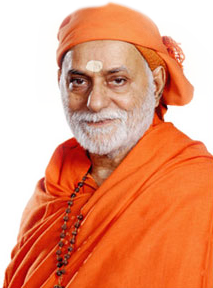
Words of guidance spoken by Swamiji in the mornings. This book titled Morning Rays, compiles a few of these profound words on Saadhana.
This book is a compilation of early morning messages delivered by Poojya Swamiji in the Ashram. These morning talks came to be known as Prabhata-rashmih (Morning rays). These are profound words on Saadhana, like the effulgent morning rays, would illuminate many a dark corner in the seekers’ minds. The transcript of these talks are also published regularly in the Ashram’s monthly journal – Vicharasethu.
Vol I, contains 36 edited talks, inspires the seekers and helps them walk confidently on the path of purity, expansion and enlightenment.
Vol II presents 34 edited talks on how to make spirituality a wholesome pursuit.
Extracts from the Book:
The mind is a kind of surface expression like the waves of the ocean. The waves appear to be high and mighty. But underneath lie the immense depth and stillness of the ocean. Compared to the vastness below, what is the magnitude of the waves? So are the afflictions and agitations, likes and dislikes, joy and sorrow of the mind. Underneath these waves and ripples, lies the calm infinitude of the Self. Know this vastness. Know this unfathomable depth. Let the waves and ripples of the object impressions play on the surface. But you remain poised in the uniform taintless vastness of the Subject.
* * *
What is this purity? How can one judge whether he is becoming pure or not?
First, purification means reduction and extinction of desires. The desires may be secular, worldly, or they may be spiritual, otherworldly. In Vedanta, vairaagya is defined clearly as: Iha-amutra-phalabhoga-viraagah – disinterestedness towards enjoyment of pleasures or rewards in this world as well as in the other world. So, the secular as well as the spiritual desires will have to fall completely. A mind which does not strive to eliminate desires cannot be considered as pursuing purity.
The second aspect of purity is the lack of ego. With the dawning of purity, the ego must steadily decline. And finally, there is a state of extinction of the ego. What is this ‘ego’? It is a strong notion about one’s separate identity ‘I’ with regard to anything whatsoever. “I will do this” is an ego. “I will not do this” is also an ego. It will be very much evident in your tone of affirmation. In fact, any sense of doership with regard to any action done or to be done, is ego.
The third sign of purity is a feeling of non-possessiveness – nirmamatva. Possessiveness can be there only around the possessor — around the ego of possession. Any feeling of possessiveness with regard to anything – initially it may be worldly things and later on it may be with regard to even spiritual attainments – must gradually decline, and finally become extinct.
* * *
Meditation is a necessity, no doubt, especially to discover what lies within you. But be sure that its duration is always specific and short. The duration of activity far exceeds the meditative spell. You must have the necessary purity and orientation to spiritualize this non-meditative part of your life. For that, meditation can be helpful, nay complementary. The greater emphasis must be on the mind’s purity, the intelligence’s discrimination, the integration these two bring about in your active and interactive life. Introspection and perception, evaluation and examination and finally correction must become a constant companion in spiritual saadhanaa.
* * *
Moksha is the state when the mind and buddhi become free of these botherations – free of the bandhanas. Botherations can be caused by facts or fictions. We have factual botheration; we also have imaginary botherations. In imaginary botherations come all the things referring to the past and future lives. In the factual botherations will be the present life situations. The mind is unable to reconcile with a certain development. A number of desires are there. You are not able to fulfil them. So dejection follows. In the relationship around, you find disharmony. That bothers you. If everything is bad, it becomes difficult to live. If everything is good, it becomes difficult to leave.
These are all pratyaksha facts and botherations. Moksha is a clarity, a freedom that you need from whatever troubles you have now. If there is no trouble, you don’t need moksha. If there is no torment, you don’t want any freedom. But generally the world and the life in it are such that everyone who lives will have tension, stress and strain. These are modern days when people always speak about stress and strain. Stress and strain – actually this is what we mean by bondage. I always say that all interactions with the world objects are interactions externally; but in the ultimate effect or outcome level, they become subjective – mental, intellectual and emotional. Whenever you interact with the world, the interaction may be external and object based. But the resultant of the interactions is always in your mind. It is emotional in character. These resultants become a bothering element for you.
* * *