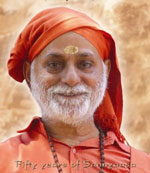
“The paths leading man to god or Truth are said to be many. I will speak only of the shortest. It is to recognize God as the Self in you and then to find Him out. What is the distance then between you and God, between you and yourself? Ah, there is no distance at all, a full Zero! Yet, how dare you say to find God and Truth is hard?’’ 

The Guiding force of Narayanashrama Tapovanam & Center for Inner Resources Development

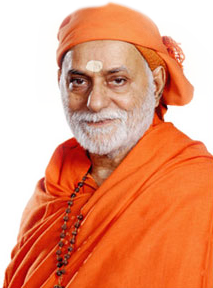
Swami Bhoomananda Tirtha

swamiji
swamiji-header-mo
Menu
Up

Prabhaata-rashmih

We like things, we dislike things. If we ask ourselves why am I liking, and why I am disliking – no answer. “I don’t like”, “I like”, “Leave me to what I want to do.” This is all what everybody will say. Shankara would say these likes and dislikes are characteristic of all creatures in this world. He always says paśvādapiśya aviśea. in the case of animals, particularly cows, etc., the likes and dislikes are there. In a herd of cows you will find one cow will hit a few, will not hit the others. Why it hits a few? It doesn’t know. Very strange. If you keep grass and go near the cow, it will come to you. If you have a stick and raise it, she will run away. This is what he says with regard to rāga-dveśas. And rāga-dveśas are capping all sensory objects. A man who is able to handle these rāga-dveśas in such a manner that whatever is to be done from time to time can be and will be done effectively, that is all what we aim at with spiritual perfection.

I think much depends upon how we are open enough to accept the developments in life. My dear seekers, students, I only have one point to tell you. Life is a kind of a course, like the flow of a river. Which direction it will take, how fast it will flow, what are the terrains it is going to pass through – no definiteness at all. It starts flowing from the peak of a mountain, from somewhere, it all depends upon the terrain and the obstructions. One, I can change the direction of a river, provided we block it in the original one point. So the river that is flowing in a certain direction will flow in another direction. But it will flow. The same manner, our life is indefinite, no doubt, but it will flow.

The purpose of reading the scriptures, listening to them, cogitating or ruminating over them is to give the mind an association with all these good things. When we read Bhagavad Geeta, about seven hundred verses; when we read Bhagavatam, generally it is said to be eighteen thousand verses; all these are – great associational impact it makes on the mind. I think by simply reading and imbibing, you will be able to automatically display these virtues.

In whatever way you may argue, transitoriness is a fact that cannot be refuted. There are things which become transitory in a very short while. A thought comes, soon it disappears. So the transitoriness is very, very, very, very fast. When we are looking at the sun, every second it is changing. We are not able to understand the changes in our own personality and a number of articles outside. You make a good new furniture, ever since the day it is made and you have brought it home, it starts aging. The aging was there even earlier.

Once you understand that very thing is subject to change, transitory everything is, what should be the response in you? It should be one of dispassion. So the dispassion is to be cultivated and this cultivation takes place when you use your viveka and dwell upon the plight and fate of everything in this world.

We divide things into moral and immoral so that you will be initiated into a process of exclusion or abandonment. Half of the creation you can keep away and half you accept. Now once you have learnt to renounce half, gradually you will have the impetus and the ability to renounce everything. When thus everything is left mentally, you attain the supreme truth. It can be described as transcending everything or denying everything. It is either non-dual or all-fold.

Liberation is an inevitable factor, so far as your life in this world is concerned. If you want to live here freely, joyously, comfortably, with confidence, ready to assimilate any impact that the world gives you, equally ready to generate any extent of output necessary for performing in any field and achieving the maximum; you must have a sense of freedom. Your mind should not be a narrow one, it should be a broad one. Instead of having a well dimensional mind, you must have a lake dimensional mind. From there you go into the oceanal mind and finally end up with a spatial mind and it is absolutely possible.

Our mind should constantly be fixed on the sat lakshya. What is the objective of human life? What is it that you want? The world has been going on, so many people have lived here, done many things, finally gone…. you will also one day go to the cremation ground. So what is it that you want in life, either in the way of a take or in the way of give? Should your mind be fixed on the transitory, or on the non-transitory, eternal, supreme? If there is a cyclone and you are on the top of a tree, suddenly the wind blows and the branch of the tree also swings, what will you do? You will somehow creep in and come to the central trunk. That central trunk will not swing at all. So, you also will not swing. Similarly, should you rest upon the eternal and remain unshakeable, or should you cling to the transitory and remain shaky? So let the mind and the intelligence be fixed on the sat, the non-changing, the change-less!

The word śraddhā in Sanskrit means something very precious and very specific also. I don’t think there can be an English translation for this word, śraddhā. But nevertheless I have been using two words to indicate what śraddhā means. What is that? Assiduous application. Whenever you are able to apply your senses, mind, intelligence, heart towards anything in an assiduous, wholesome, tenacious, persevering manner, then it becomes śraddhā. There are many people who are not able to do it.

So, uparati is that art and process and habit, whereby you simply close your eyes. Do not indulge in or interact with anything. On the other hand, allow the mind to rest on its own essence. When you close your eyes, the eyeballs will not roll. The eyeballs will roll when you are unable to close your eyes. So, uparati is that kind of a withdrawal from the sensory objects, whereby the senses do not gallop for any kind of an interaction. It simply remains itself.

 titikā literally means the readiness and ability to withstand and forbear any kind of a torment or affliction which results during the course of your life, no matter from whatever agency it comes. Sreemad Bhagavata would put such torments as threefold - ādhyātmika suffering, ādhibhautika suffering and ādhidaivika suffering. ādhyātmika suffering, the word atma refers to oneself. ādhyātmika therefore means self generated, self caused, self born, self derived. What are such sufferings?

The jñānendriyas are used to glimpse, perceive and understand the objects. As soon as you glimpse or perceive the objects – that glimpsing itself is when the mind takes an imprint of the objects by itself in itself, to remain in itself. It becomes a memory, a store of the mind. When the mind makes such an imprint, it not merely makes an imprint, it also responds to and reacts to the imprint. This response and reaction are natural, irresistible, spontaneous and even ceaseless. That is where we develop our likes and dislikes, desire, hatred, fear and their permutations and combinations. So the senses come only as a media, as a medium.

What wants to see is the mind. What sees is the mind. What takes an imprint is the mind. And what employs or uses the imprint is again the mind. Unfortunately we feel, in the whole process, the senses are more dominant than the mind. It is actually a kind of a delusion or a sudden understanding of the whole process. This suddenness, we should always safeguard against. Let us make use of the mind and intelligence to observe, to understand, to evaluate and assess matters properly.
All the poets are those people who see things just like we are seeing, but the poetic vision, the poetic mind will always look at it and relate it to a value or a lesson of life. That is why poetic statements live forever. All the other prose writings will vanish after some time but poetic writings are always bringing forth value from the different sights, scenes, episodes, character, behaviour, interaction, etc. I think this is nice to know. We have a number of subhashitams, proverbial statements. Each one verse of a subhashita Is sufficient to change and give a direction to one’s life! So many we have!

In the company of external objects, interacting with them, what is put into action is your own mind and intelligence. In Sanskrit, we call it chitta-vrittih. vrittih means the vyaapara, the activity of the chitta, means the mind. All jnanas are vritti-jnanas. All knowledge is vritti-jnana. What is meant by vritti? vyaapara – activity. Understand very clearly, the source of knowledge is within the body and it is not in the bodily level, it is not in the matter level or energy level. Neither matter nor energy is capable of thinking and giving rise to knowledge. But we have a lot of knowledge about matter and energy. The source of knowledge is inner and it is supra-material and supra-energial and mind is one such, intelligence is another.

Every desire and external object, like a set of sofa - you may possess it. Quite alright! We have no objection. First of all it is a desire and the desire is sprouting in the mind. You are following the desire in the external sphere as a result of which you get the furniture and put it at home. Very good! I have no objection. Is it the arrival of the furniture that really counts or following the arrival, whatever desire the mind had, that desire has become extinct. Suppose the desire continued to be there, then you would again run after the furniture and procure it. Mark my words very clearly! Don’t get confused! I want you to be bold, simple and upright!

It is a desire of the mind that you pursued and after pursuit, it is the desire of the mind that becomes extinct. So when you pursue a desire and fulfil it, what happens? Where the desire originally began, there itself it becomes extinct. So desire fulfilment means what? The absence of that desire, its extinction. When all the desires are fulfilled, what will happen? The desired objects will be around you but so far as the mind is concerned, it is extinction of the desires that takes place.

When we discuss purity of the mind, we are not discussing purity of the mind as a picture drawn on the sky. Certainly not! Mind you have, and the mind should become pure. So when we discuss purity, you understand it and when you understand it, you start making an effort to make your mind after that. So try to know the impure elements, examine whether you have, if you have, the very description that it is impure makes it very clear it should have no place in you. 

An infection in the body – will it have any place in the body? Our system itself tries to subdue it and throw it away. So infection, by its very nature, is not something very acceptable. Even if you don’t know it, our body will try to fight against it. Similarly, impure elements are such that they have no place in your system. The knowledge that these are impure is more than sufficient to launch a pursuit, a dedicated pursuit to get rid of them.

I thought of discussing vairagya. vairagya literally means dispassion. The word dispassion nowadays is being used in management science also. Generally what we say, “He made a passionate appeal”, “I am very passionate about achieving”, etc. These are all alright. But the principle of moderation and sublimation is the one that is going to make the inner personality of any one qualitative, deep, lofty and really sustaining and achieving. Any kind of an extreme in whatever we think, do and act is not at all good.

Suppose you swing a cradle or a pendulum. It remains so only when it is able to go to one extreme and come back and have an offsetting extreme this side. Ultimately what does it do? Both the swings become lesser and lesser, lesser and lesser, until at last it comes to a stop. So stability is very important.

Right at the time of creation, every being, every creature is gripped by a delusion, which expresses itself in the form of love and hatred. A newborn child, if you put something sweet, a little sweet drop is given, it will start licking it. Suppose you put something bitter, it will not like it. Now who told the child to dislike the bitter and like the sweet? Like that you will find every animal, every creature, including the human being, we are suffering from a delusion imposed by the mind, which expresses itself in the form of two opposite urges. One is pleasing, another is displeasing.

Now moksha is the freedom and redemption from this kind of a shackle. And so far as intelligence is concerned, it’s always having a doubt, a question and lack of clarity. Because we don’t have clarity the mind is allowed to swing in many many ways.

You will find, if you incorporate viveka in your life, your life will be much more adorned, enriched and empowered. While applying viveka, you can be focused on the external objects and interactions which you have every day. Equally so, you apply viveka to your own internal workings and processes. “In all my interactions, have I had the right attitude? Did I have the right response? Did my mind react always properly and well? Or there were mistakes, errors, eruptions and what-not.” So apply the viveka with regard to your internal working, inner personality. “Could I have done this better? In what way I could have improved matters?” One important viveka I would like to tell you is that – in all our interactions, there is always a tendency for us to blame others. “Oh! He did not understand when I said it. He is not good!” It is agreed that he is not good, he doesn’t understand. Your question should always be “How can I still be effective with such a person? How can I be effective with such a person?”

Generally the viveka is to go into some of the functional and interactional details of substances, persons and the like. For e.g, I said the eyes are always distinguishing between colours. The ears are distinguishing between sounds. But what kind of a viveka we mean in the case of a seeker? That viveka is focused in order to find out – of all the substances including our body with which we live in the world, is there anything permanent and lasting? Because we find everything is changing. The earth is changing, air is changing, water is changing, our own body is changing, mind is changing, intelligence is changing, ego also has its undulations, so the gross and subtle things which constitute the universe are found to be constantly in a state of flux, change. So, the question necessarily arises; our body itself is changeful and whatever we acquire with this body, they are also changeful. So changefulness multiplied by changefulness will only become changeful squared. And what is meant by a change – mark my words - what is meant by a change? Whatever is now, it becomes extinct and in its place something else comes. So change implies extinction and emergence. Though we call it change, it is actually “whatever is the present form of a substance, that disappears and something else in its place arises.” So every change implies destruction. So the whole world including our body is destructive. It is getting destroyed. Naturally the question arises; what is this? Should I not have something indestructible, something which does not change off?

To be a seeker means to have a definite enquiry in one’s life. This enquiry is a derivative of the mind, heart or intelligence. It may be a yearning of the heart, a compulsion of your emotions, or maybe a very patient and sustained enquiry by the intelligence. So whenever a person becomes a seeker, he must have something as the to-be-sought and gained. Now such a kind of a characteristic is not very common. We may have a number of devotees who love God, fear God, respect God, who like to think of Him and remember Him. None of them may be a seeker. To be a seeker clearly means to have a persistent enquiry. “I would like to know what is God. I would like to know is there any soul. I would like to know the meaning and purpose of life. I would like to know what is meant by liberation. Is there any heaven? Is there any hell? Is there a life before the birth of the body, and after its death?”


Powered by Phoca Download
FacebookMySpaceTwitterStumbleuponLinkedin
Pin It